You Can See Everything (2026)
Nothing in this film is what it claims to be, starting with the title. You Can See Everything is a documentary about a convicted liar, made by two professional fabricators, and it lies to you while telling you it is lying. I sat with it a long time after it ended, and I am still not sure it has finished with me.
The directors are Nathan Fielder and Lance Oppenheim, and the pairing matters. Fielder built his career on The Rehearsal, constructing fake realities to control real outcomes. Oppenheim's Ren Faire blurred staged and real until you could not find the seam. These are not journalists who found Elizabeth Holmes. They are two men who manufacture reality for a living, pointing a camera at a woman who manufactured reality for a living. The film begins 34 days before Holmes reports to prison in 2023 to serve an 11-year sentence for fraud, and it follows her and her partner Billy Evans through those last weeks of freedom — Fielder and his crew embedded in their lives, Fielder himself staying at the couple's San Diego beach rental. Access like that is never free, and the film knows it.
And consider how the film came to exist at all. Holmes reached out to A24 — she was looking for someone to document her life. Then came the secrecy: as the Wall Street Journal reported, for nearly three years fewer than ten people at A24, a company of some 300, knew the film existed, the secrecy kept so the production could work free of interference. It was shot by a crew of about seven, only four of them allowed inside her home at a time. The film premiered as a secret screening at Telluride in September 2026 — 650 people in a theater with their phones sealed in pouches, not knowing what they were about to watch until Fielder walked out and introduced it. Amanda Seyfried's involvement never leaked either; A24 kept her out of the marketing completely, so nobody who bought a ticket knew she was in it. A film about performance and control was itself controlled like a state secret. That is not a coincidence. That is the method matching the subject.
You Can See Everything is about manipulation, at every level. Holmes manipulated scientists and investors, raising nearly a billion dollars on a blood-testing machine that never worked. Billy may be manipulating her. And Fielder and Oppenheim are manipulating us — through editing, through scripts, through actors recreating scenes that exist only in Nathan's memory.
Billy Evans is a frightening case. He is portrayed as resentful and vengeful, a gun-toting manipulator who enjoys total control over his spouse — stirring her eggs, running her accounts, creating an AI version of his wife, and even letting the cameras film him full frontal in the shower. The shower moment is genuinely shocking: the film shows his penis, plainly, and people in our audience were asking why a documentary crew would record such a thing. That is the wrong question. The better question is why a man would not mind a professional film crew recording him in the shower at all. One man allowed it out of narcissism. The other kept it in the film to expose the narcissism. But maybe the narcissist in this marriage is Holmes. Who is controlling whom? Are they enabling each other — or are we the gullible ones for sitting there trying to decide?
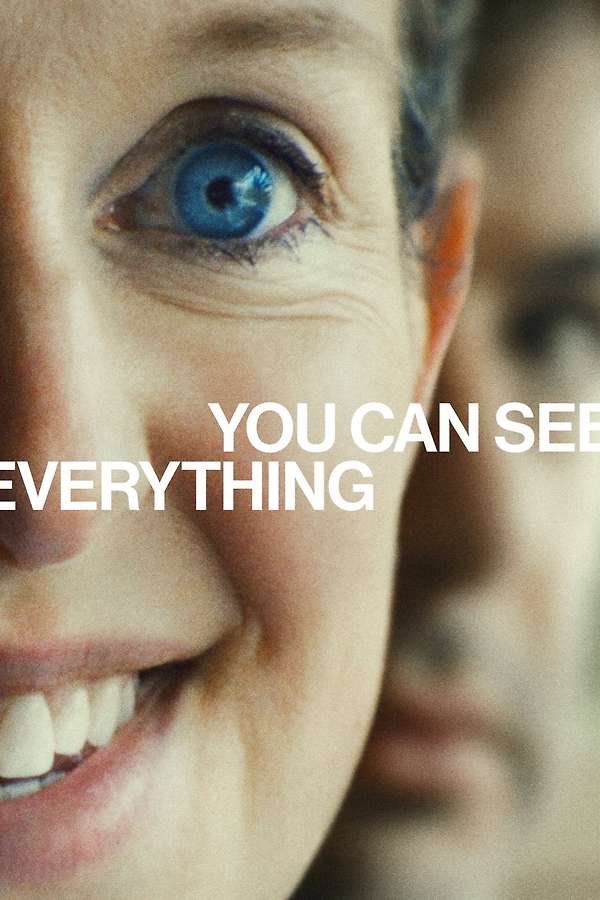
Start with the big blue eyes that stare into your soul — and the voice. That famous baritone may be the most studied part of the character. Phyllis Gardner, her Stanford professor, has said flatly that Holmes didn't have a low voice when she came to her as a student. Former co-workers have described her "falling out of character" into a higher, real voice — usually after drinking — then catching herself and dropping back down. Voice experts like speech coach Julie Foh believe it was deliberate: a lowered voice reads as dominant, authoritative, someone to be taken seriously in rooms full of powerful men. Holmes has never admitted it, and her family insists the voice is natural. But if the voice was constructed, then so was everything it sold.
And yet here is the strange thing: for all the discussion of that voice over the years, the film never asks her about it. Nearly three hours that interrogate everything — her fraud, her relationship, her memory, her honesty — and the single most famous question about Elizabeth Holmes is never put to her directly. Why? Was avoiding it a condition of the access she granted? Did Fielder ask and get nothing he could use? Or is the omission itself the point — that in a film called You Can See Everything, the one thing everyone wants examined is the one thing left untouched? A question not asked can be as constructed as a scene reenacted.
The film's smallest scene is its most fascinating. Fielder shows Holmes Abbott and Costello's "Who's on First?" She says she finds it funny. Then he asks if she understands the joke — that "Who" is the name of the first baseman, which creates all the confusion — and she admits she does not understand it at all. She cannot grasp why anyone would find it funny. Is this miscommunication? Ignorance? A defect in her personality, a mind that cannot process simple wordplay? Some people speculate she may be autistic, but even then, she could understand the joke by its context and wordplay and simply not find it comedic. So why pretend otherwise? Why make yourself look stupid — unless looking naive and vulnerable is itself the strategy, a face prepared for jurors and the public? And the humorlessness is not a small thing. "Who's on First?" only works if you can hold two meanings of the same word at once — the very thing this entire film is about — and Holmes cannot do it, even with the joke explained to her. A person who cannot let a word mean two things may be a person who cannot let her own story mean two things either: she cannot reflect on herself, and she cannot admit she was wrong. Elizabeth Holmes believes she did nothing wrong. She continues to stand by it, though the evidence is overwhelming.
Then there is Amanda Seyfried. She is not a neutral presence in this film. She won an Emmy playing Holmes in The Dropout, and her Holmes was a sympathetic one. So when Seyfried — playing Holmes again, in reenactments — turns on Fielder and questions his biases, she is defending her own construction too. There are two invented Elizabeths in that room arguing about a third, real one who is not present. And the trap closes on the director: the interviewer becomes the interviewed. You watch Fielder wonder if he has fallen victim to her manipulation, feeling empathy and even caring for this mother who struggles to shed one tear. There is one shot of him swimming with her, enjoying himself. They got closer during this shoot. The film lets you see it happen and dares you to feel superior to him for it.
But notice who is not in this film. The victims. Three years of intimate access to Holmes and Evans, and the patients who received false Theranos results — people who were told wrong things about their own bodies — are essentially absent. So is Sunny Balwani. That is a structural choice, not an oversight. The film's sympathy problem exists because the harmed people were never given a stage. Holmes gets to be a puzzle. They do not get to be people.
And what does Holmes get out of all this? She initiated it. She went to prison with the last word being a beautiful, ambiguity-rich portrait that treats her as a fascinating enigma rather than a convicted fraud. She will be released while she is still young enough for a second act. Whether she planned it or not, this film is the first brick of her rehabilitation.
Then there is the money, and the scene that may be the film's most quietly damning. Holmes goes upstairs, and Billy — alone with Fielder — asks about profiting from the documentary. About getting a cut. And this was no idle question, because the film reveals what she handed him before she went in: power of attorney, signed before she reported to prison in 2023. That authority makes Evans the manager of Elizabeth Holmes as a public property. He can license her likeness for billboards and negotiate back-end profits from her film appearances. He controls the AI-generated avatar of her, a digital likeness created before her sentence began. He promotes her image and runs her campaigns. And while she sits in prison, he manages and tweets from her X account under her name, posting and replying to people in words that are not hers. Her face, her voice, her feed are assets now, and he holds the paperwork — all of it usable for profit, even when it puts her in a bad light.
So was the scene upstairs rehearsed? Did she leave the room on cue so he could make his ask, then play dumb about it afterward? She signed the document — the "in the dark" defense gets harder to hold. Or is that exactly what control looks like: not a husband asking permission, but a man who had already been given legal command of who she is in public? Either version is ugly. If she knew, the marriage is a partnership in the con. If the signature was its own kind of surrender, then the man stirring her eggs and running her accounts also owns the rights to sell her. And the irony lands at the box office: for all that authority, Billy got nothing from this film. The documentary he tried to take a piece of became one of the highest-grossing documentaries of the year.
All of it culminates in the final reenactment, which destroys itself on purpose. The last conversation between Fielder and Holmes took place in prison, where no electronic equipment of any kind was allowed — he went through security, so there was no hidden recorder. There is no way he recalled that entire conversation verbatim. The film lampshades this: he misremembers a word, then re-remembers it, and he changes a word in the script after Seyfried points out that the original was incriminating toward Liz. On the surface this is honesty. Underneath, it may be the most manipulative edit in the film — because a magician who shows you one honest moment buys your trust for everything you did not see corrected. The visible fix is transparency performed.
That is the film's real subject: memory, framing, and how one word changes an entire meaning. It is right there in the New York Times quotation the film keeps circling — "a character I created" versus "a character they created." One word shifts, and the narrative of Elizabeth Holmes shifts with it. Every reenactment before the prison scene at least had a plausible explanation for how Fielder could know the dialogue. The prison scene has none, and the film presents it anyway, and then confesses. So what is being presented as factual — the gist, a few turns of phrase, or nothing but Fielder's interpretation wearing the costume of fact?
Reenactments have been part of documentary since the beginning, but only a small family of films has really deconstructed what is real and what is trickery. The grandfather is Orson Welles's F for Fake — a film about an art forger and a fake biography, hosted by Welles himself, a magician who promises his audience the truth and then admits he has been lying to them. Then there is Abbas Kiarostami's Close-Up, in which a movie buff who had impersonated his favorite director, Mohsen Makhmalbaf, plays himself in reenactments of his own fraud, alongside the real family he deceived — a nobody who loved cinema so much he stole a director's identity, then got to recreate the whole deception for the camera, with the real Makhmalbaf himself waiting at the end of it. Errol Morris's The Thin Blue Line turned the reenactment into an investigation, each version of the story contradicting the last. Joshua Oppenheimer's The Act of Killing handed reenactments to murderers and let them stage their own crimes as movie scenes. You Can See Everything belongs in that family — and pushes it one step further, because here the reenactments are staged not by the deceived or the killers, but from the memory of a director who may have been deceived himself. It is, in the best sense, an untrustworthy film about untrustworthy people — and one of the best and most thought-provoking films of the year.
Are the performers being exploited — or are the viewers?
As an eBay Partner, Classic Art Films may earn a commission from qualifying purchases made through links on this page.
Follow my film diary on Letterboxd.