Agnès Varda
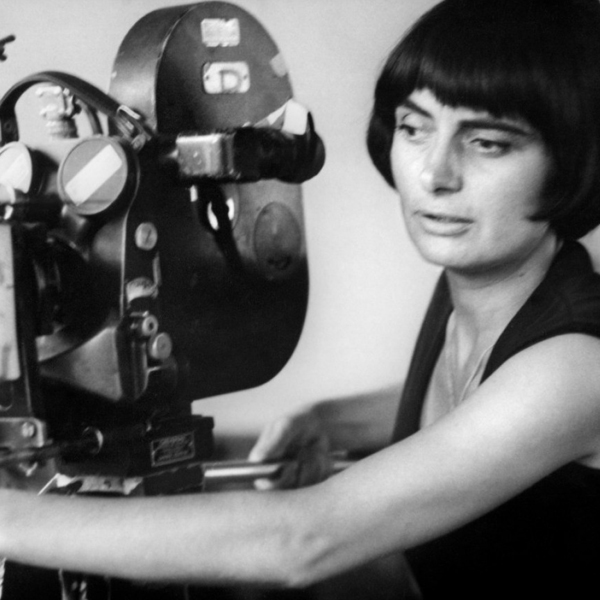
Director Agnès Varda is looked at by many critics as the ‘Godmother’ of the French New Wave and yet besides her being a woman, it seems a little unfair to simply describe her like that. It seems most critics would use that term just as a way to distinguish her among her other male comrades like Godard, Truffaut, Rivette, Rohmer, Resnais, Chabrol and her husband Jacques Demy. Unlike most of the New Wave directors, Varda admitted to not seeing many films when she was young. Besides being trained as a filmmaker or film critic, Varda was also a highly professional photographer and documentarian; which is quite obvious through Varda’s extraordinary cinematography.
Throughout her career Varda’s films, photographs, and art installations focused on documentary realism, feminist issues, and social commentary — with a distinct experimental style. Varda’s work is often considered feminist because of her use of female protagonists and creating a female cinematic voice. Many of her films use protagonists that are marginalized or rejected members of society, and are documentarian in nature. In Varda’s greatest cinematic masterpieces Cleo from 5 to 7 (1962), Vagabond (1985), and The Gleaners and I (2000) she brilliantly incorporates both the French New Wave and documentary aesthetics, effectively blurring the lines between fiction and reality and ultimately creating a new representation of the new modern woman. The French New Wave movement at the time was essentially broken into two subgroups: the Cahiers du Cinema group and the Left Bank Cinema group. The Cahiers du Cinema group was looked at as more famous and financially successful. Most of the critics like Godard, Truffaut and Chabrol were younger and much more hardcore movie buffs.
The Left Bank New Wave group of Alain Resnais, Chris Marker and Agnès Varda, were a contingent of filmmakers who were slightly older than the Cahiers du Cinema group. They tended to see cinema through the themes of abstract memory, surrealistic dreams and experimental filmmaking. As significant as the French New Wave movement was in exploring the themes of female representation and postwar feminism, surprisingly director Agnès Varda was the only female director among all the French New Wave comrades. Varda has stated on various occasions that she claims no prior influence to the New Wave movement; nonetheless her first feature La Pointe Courte (1954) remains a clear influence and helped pave the way for French New Wave filmmakers. Agnès Varda has never been comfortable with being included within the New Wave, much less the Left Bank Group: “It is not my fault I made a movie just before the New Wave. But I cannot control how histories treat me as a precursor.”

Agnès Varda, often called the grandmother of the French New Wave, made her first feature, La Pointe Courte, in 1955, and Cléo from 5 to 7 (1962) remains her most collected film; in a 2019 BBC critics' poll it was voted the second-greatest film directed by a woman. Foreign posters for Cléo are especially prized, such as Jaroslav Fišer's Czech poster, the Italian 4-foglio by Nano Campeggi and the Japanese poster from 1964. French re-release posters from 2012 and later are easier to find but should not be confused with the 1962 originals. Varda was also a photographer, and later films such as Vagabond (1985), The Gleaners and I (2000) and Faces Places (2017) have their own following.
See more Agnès Varda memorabilia on eBay ›
Current listings from eBay. As an eBay Partner, Classic Art Films may earn a commission from qualifying purchases.
Articles and Essays on Agnès Varda
Agnès Varda receives an Honorary Palme d’Or at Cannes

Influential French New Wave filmmaker Agnès Varda received an honorary Palme d’Or at the 68th Cannes Festival. The Palme d’Or award goes to directors whose work achieved a culturally and global impact to world cinema. Her winning followed in the footsteps of such legendary greats Woody Allen, Bernardo Bertolucci and Clint Eastwood. Her career is […]
Continue
Cleo from 5 to 7 (1962)

It is said in France that between the afternoon hours of five to seven, those are the magical hours that lovers first meet one another. And during these two hours of Agnes Varda’s film Cleo from 5 to 7, nothing can be further from the truth. (Even though technically the film is clocked in at only 90 minutes.) […]
Continue